

Short answer: a spin bike suits instructor-led classes and steady rides, because riders control a weighted flywheel at a set resistance. An air bike suits short, all-out intervals, because the fan pushes back harder the more effort you put in and the arms work too. Most commercial gyms with a class studio and a conditioning area end up with both.
That is the decision in one paragraph. The rest of this guide covers what actually changes on the gym floor: how each bike makes resistance, which sessions it suits, how loud and how big it is, and what your staff will be fixing six months in. The specs come from our own quotation for the spin and air bikes we build at our factory in Shandong, China, so you are comparing real machines, not a category label.
| Spin bike | Air bike | |
|---|---|---|
| Resistance | Weighted flywheel with friction or magnetic resistance, set by the rider | Fan (on a conventional air bike); resistance rises with effort |
| Best use | Group cycling classes, steady rides, endurance work | Short intervals, conditioning circuits, full-body efforts |
| Arms | Static handlebars | Moving handlebars on a conventional air bike |
| Relative noise | Lower, especially with magnetic resistance | Higher at hard efforts, from fan airflow |
| Upkeep touch points | Belt, brake pads (friction models), seat and bar adjusters | Fan and fan guard, handlebar pivots, drive |
How each bike creates resistance
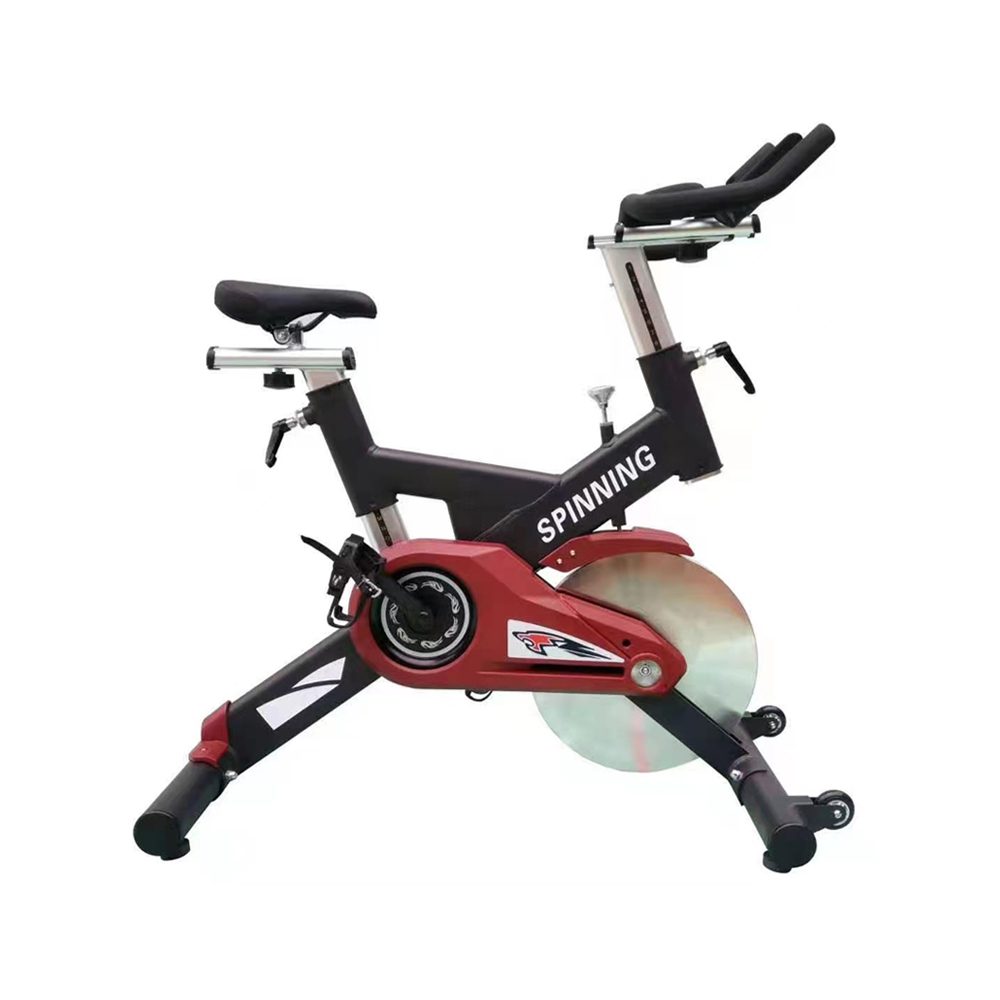
On a spin bike, the rider turns a heavy flywheel through the cranks, usually by a belt. Resistance comes from a brake acting on that flywheel. On friction models it is a pad pressing on the wheel; on magnetic models, magnets sit close to the flywheel and never touch it. Either way, the rider turns a knob and the bike holds that resistance until they turn it again. The four spin models in our table below carry 15 to 20 kg flywheels, and that weight is what gives a spin bike its smooth, road-like feel once it is moving.
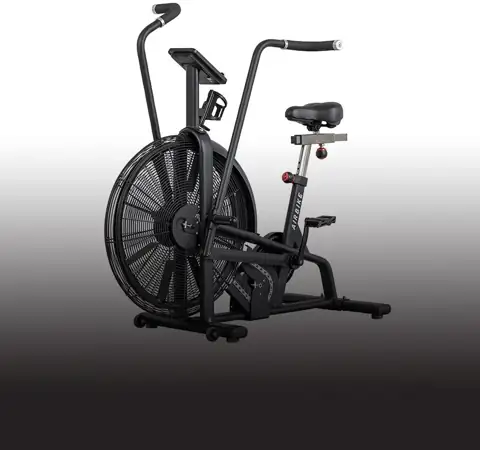
A conventional air bike works the other way round. There is no knob doing the heavy lifting. The pedals and the moving handlebars drive a large fan, and the fan’s air resistance climbs steeply as you pedal faster. Ease off and it gets easier straight away. That self-regulating resistance is why coaches like it for intervals: a beginner and a strong athlete can share the same bike and both be working at their limit.
Not every bike sold as an air bike is built the same way, though. Some of our air models list resistance shifts in the spec sheet, and our commercial air bikes range also includes a magnetic resistance model. Read the spec for the exact model you are quoting, not just the category name.
Class use vs conditioning: where each earns its floor space
If you run a cycling timetable, the answer is simple. Buy spin bikes. A class of twenty riders needs bikes that adjust quickly between sessions, feel the same from one bike to the next, and let the instructor call out resistance changes that everyone can follow. A fan bike can’t do that, because nobody is “at level 6” on air. Spin bikes also suit members who just want a steady ride with headphones in.
Air bikes earn their place in a different part of the gym. They belong in the conditioning or functional area, where a coach runs short work-and-rest rounds, team workouts or a finisher at the end of a strength session. Because the arms work too, an air bike gets heart rates up fast and keeps the upper body busy. It is also forgiving for mixed groups, since the bike scales itself to each person’s effort.
Where we see buyers go wrong is putting air bikes into a cycling studio to “add variety”. We don’t recommend it. The bikes are louder, the class can’t follow a shared resistance cue, and members who came for a ride end up on a machine they didn’t choose. Equally, a row of spin bikes in a conditioning zone tends to sit empty during coached sessions, because the format calls for something that punishes a sprint.
A rough rule for your own floor: count the sessions on your timetable. If most are rides, spin bikes come first. If most are coached intervals and circuits, start with air bikes. If you run both, you need both, and the ratio should follow the class schedule, not a catalogue.
Noise, footprint and room layout
Noise is the point gym owners ask about most, and it is mostly a question of resistance type. A fan air bike moves a lot of air, and the sound rises with effort. In a busy conditioning zone with music on, that is part of the atmosphere. Next to a treatment room, a quiet stretching area or an office, it can be a problem. A magnetic spin bike is usually the better starting point for a quieter cycling area, because there is no pad contact and no fan. We don’t publish noise measurements for these bikes, so if sound matters for a room, test the selected models and think about the room’s acoustics before promising anything to a landlord or neighbour.
On footprint, the two types overlap more than people expect. In our 2024 quotation, the spin models in the table run from 1,010 to 1,560 mm on the first listed dimension, and the air bikes from 1,293 to 1,400 mm. The larger difference is how the bikes are used. Air bikes in a conditioning zone are often rotated between stations, so they need clear space around them and a sensible route for moving them. A fan also blows air forward, so we wouldn’t line air bikes up nose to tail facing the rider in front.
Spin bikes in a studio are usually set out in fixed rows facing the instructor. Plan the row spacing so riders can get on and off without climbing over each other, and leave room for staff to reach the adjusters. If you are laying out a mixed conditioning floor with bikes, rowers and free space, our guide to hybrid training floor planning goes station by station.
Upkeep in a busy gym
Neither bike is high-maintenance, but they wear in different places. On spin bikes, the drive belt and the resistance system take the most use. Friction models have brake pads that wear and need replacing; magnetic models avoid that contact. Seat posts, handlebar posts and their pop-pins get adjusted many times a day, so check that they lock firmly and that nothing rattles. Sweat is the quiet enemy: wipe down frames, flywheel covers and adjusters after classes, or corrosion shows up on the parts members touch most.
Air bikes have fewer adjustments but more moving parts at the front. The handlebar pivots and linkages take a lot of force during sprints and should be checked for play. Dust and lint collect in the fan and fan guard, so cleaning the guard is a routine job, not a once-a-year one. Pedals and straps on both types wear faster than most parts of the bike.
The practical step is the same for either type. Order a small kit of common spare parts with your first shipment, and get the warranty and parts process in writing before you choose the final mix. TMAX Fitness gives a 1-year warranty on the whole machine.
TMAX spin and air bike specs compared
These are the figures from our 2024 TMAX Cardio Series quotation for the models we list on our commercial spin bikes and air bike pages. Where the quotation doesn’t state a value, the table shows “—”. Product sizes are in millimetres, in the order the quotation lists them. Final specifications are confirmed with your quote.
| Model | Type | Drive / resistance | Flywheel | Product size (mm) |
|---|---|---|---|---|
| TX303 | Spin bike | Belt drive | 15 kg | 1050 × 560 × 1000 |
| TX305 | Spin bike | Belt drive | 15 kg | 1010 × 580 × 1170 |
| TX307 | Spin bike | Belt drive | 20 kg | 1560 × 560 × 1200 |
| TX308 | Spin bike | — | 18 kg | 1250 × 520 × 1350 |
| TX311 | Air bike | — | — | 1293 × 592 × 1229 |
| TX313 | Air bike | 10 resistance shifts | — | 1350 × 1200 × 650 |
| TX314 | Air bike | 8 resistance shifts | — | 1400 × 780 × 1340 |
Two things are worth reading from this table. First, the heavier 20 kg flywheel on the TX307 gives more momentum, which riders tend to feel as a smoother pedal stroke. Second, the TX313 and TX314 both list resistance shifts, so ask how that adjustment works if your coaches want a fixed setting for some drills. For the full range, see all our exercise bikes.
Should you buy both?
For most commercial gyms, yes, but not in equal numbers and not in the same room. A typical full-service gym puts a row of spin bikes in the cycling studio and a smaller group of air bikes in the conditioning area. A hotel gym or a small studio with one open room usually does better with one or two spin bikes for steady rides, and an air bike only if a coach or personal trainer will actually program it.
We would size the order from three questions. How many people are in your largest cycling class? How many bikes does your biggest coached circuit use at once? And which rooms can take fan noise? The answers give you a spin count, an air count and a location for each. If you are buying for a new site, send us your floor plan with the timetable and we can build the bike mix around it.
If this is your first order from a factory, our guide on how to buy gym equipment from China covers spec sheets, voltage, inspection and after-sales. At TMAX Fitness, a commercial gym equipment factory in Shandong since 2015 that has shipped to 80+ countries, the MOQ is 1 unit and production usually takes 7–30 days.
FAQ
Should a commercial gym buy spin bikes or air bikes first?
Buy spin bikes first if instructor-led cycling and steady rides are central to your timetable. Choose air bikes first if coaches mainly run short conditioning intervals. A facility offering both formats may need both types. Base the mix on actual sessions and available floor space, not a universal claim that one bike is better.
What is the resistance difference between a spin bike and an air bike?
A spin bike uses a weighted flywheel with adjustable friction or magnetic resistance, depending on the model. A conventional air bike uses a fan whose resistance increases with effort, usually with moving handlebars. Compare the actual TMAX model specification: a category label alone does not describe every resistance system or drive arrangement.
Which bike is quieter for a gym near classrooms or treatment rooms?
A fan air bike normally produces more airflow noise as effort rises. A magnetic spin bike is often a better starting point for a quieter cycling area. TMAX does not publish noise measurements for these bikes, so check the selected models in use and consider room acoustics before promising a particular noise level.
What should I compare when ordering commercial bikes from a Chinese factory?
Compare resistance, drive type, adjustment range, product dimensions and service access model by model. TMAX Fitness supplies commercial equipment to EN ISO 20957 Class S and accepts orders from one unit. Keep the specification sheet with your order, and agree spare parts and warranty terms before choosing the final mix of bikes.
Get a quote for your bike mix
Send us the models you are considering, or your floor plan and class timetable, plus your destination country. We reply with pricing, lead time and shipping options for your market. Request a quote.